Russia is training teenagers in the occupied territories in propaganda through the “Young Correspondents” program

Russia is training teenagers in the occupied territories in propaganda through the “Young Correspondents” program

Trips to Russia, master classes from Kremlin-aligned media figures, and lessons in Soviet military glory. Through its “Young Correspondents” program, Russia is training teenagers in occupied Ukraine to promote the invasion and wage information war on Moscow’s behalf.
Henichesk, a small resort town on the Azov Sea, was one of the first Ukrainian population centers to fall to the Russians.
As tank columns streamed north from occupied Crimea on the very first days of the February 2022 invasion, some 19,000 people suddenly found themselves living under Russian occupation.
For one local teenager, it was the beginning of a life-changing personal reorientation.
February 23, 2021:
A year before the invasion, 12-year-old Kateryna records a video for her Henichesk school, extolling the importance of the Ukrainian language.
October 6, 2025:
The Russian Agency for Youth Affairs awards Kateryna, now 17, an 800,000-ruble ($10,500) grant to “develop patriotic education” in occupied areas.
What happened in these 1,686 days?
Kateryna is no exception. She is the product of a Russian program that is turning dozens of Ukrainian children from occupied territories into pro-Moscow propagandists.
Called “Young Correspondents” — and funded by the Russian state — the program trains participants to wage information war against the Kremlin’s enemies.
Above all, they must promote the invasion of Ukraine.
To understand how this Russian propaganda factory works, reporters completed its video course and obtained hundreds of pages of internal documents.
Then they followed the young participants’ journeys, from their first publications to their government awards.
Their stories — the Ukrainian patriot turned Putin fan, the radicalized daughter of a frontline soldier, the new proponent of Soviet glory — illustrate the various faces of the Kremlin’s youth project.
Above all, they reveal the hyper-militarized environment Russia is building for its youth — and for those now living under its rule.
Late one night in the summer of 2023, five teenagers from Ukraine’s occupied Donetsk region boarded a train in the southern Russian city of Rostov-on-Don. They were on the way to Moscow.
When Russia launched its war on Ukraine in 2014, they were still young children. Now they were future war correspondents, learning to relay Kremlin propaganda on Russian military operations.
The five are accompanied by 48-year-old Alexey Linev. In Russia, he’s a sergeant who leads a grenade-launcher unit; in Ukraine he’s suspected of war crimes over his role in the militarization of children in occupied territory. Less than a year later, Russian media would report that he had been killed in action.
Meanwhile, three other groups of teenagers and accompanying adults from other occupied Ukrainian regions are already en route to the Russian capital. Their destination is the first national “Young Correspondent” media forum.
From July 28 to August 1, 2023, at least 18 youths from occupied Ukraine joined over a hundred Russian participants to learn how to convey the “truth” about the events of the Russian-Ukrainian war. Their three-day agenda included meeting with soldiers from the front lines, hearing a lecture on “social engineering” in the “era of new media,” and other sessions.
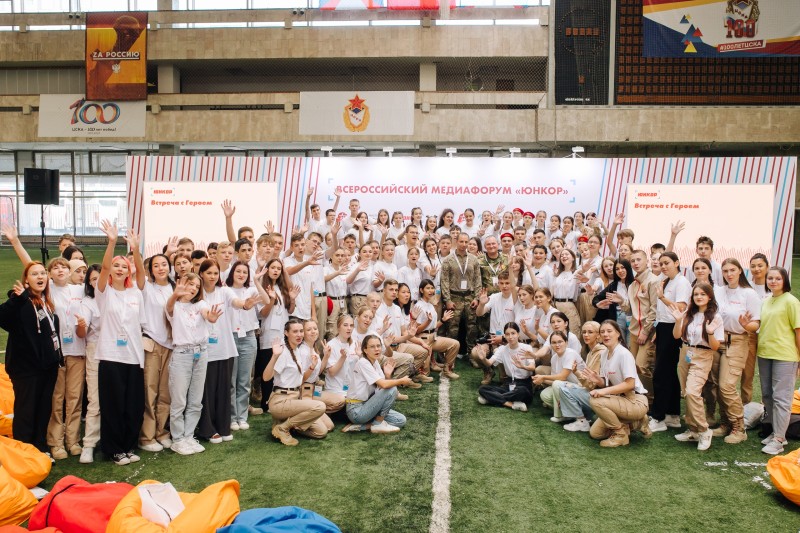
Young participants at the 2023 media forum in Moscow pose with veterans of Russia’s war on Ukraine.
The media forum is just one highlight of the “Young Correspondents” program. In some ways, the initiative — referred to in Russian by the abbreviation “Yunkor” — resembles a journalism club: Participants attend online training, create news reports, record interviews, and attend master classes with experienced journalists.
But there’s no mistaking Yunkor’s mission. It is organized under the auspices of “Yunarmia” (“Young Army”), a militarized youth organization supported by Russia’s defense ministry and funded by state money. And among its explicit goals is for participants to produce content in support of Russia’s invasion of Ukraine.
What Is Yunarmia?
Yunarmia — officially the “Yunarmia All-Russian Military Patriotic Social Movement” — is a mass youth organization founded in 2016 on the initiative of then-defense minister Sergei Shoigu.
Since it was founded in 2017, the Yunkor program has grown to about 5,000 participants, according to the Yunarmia website.
Internal Yunarmia documents obtained by reporters show about 140 active Yunkor members in occupied Ukraine in 2023 and 2024, ranging from six in the Kherson region to 60 in Donetsk.
They also show that 9 million rubles ($119,000) were spent on Yunkor in 2024, about two-thirds of which went toward organizing that year’s second media forum in Moscow, and the rest toward local expenses.
But this modest sum belies the larger Yunarmia infrastructure — like the dozens of local “Yunarmia Houses” built across Russia and occupied Ukraine — that the journalism program relies on.
According to the internal documents, Yunarmia requested 200 million rubles ($2.4 million) from the defense ministry in 2023 and received over 500 million rubles ($6 million) from the government in total. The following year, it requested a subsidy of 270 million rubles ($3 million) from the Russian budget’s education program, channeled through another Kremlin-loyal youth organization called “The Movement of the First.”
To find out exactly what the Yunkor program is instilling in the minds of Ukrainian teenagers, a reporter logged into the online school’s web platform under the credentials of a real participant.
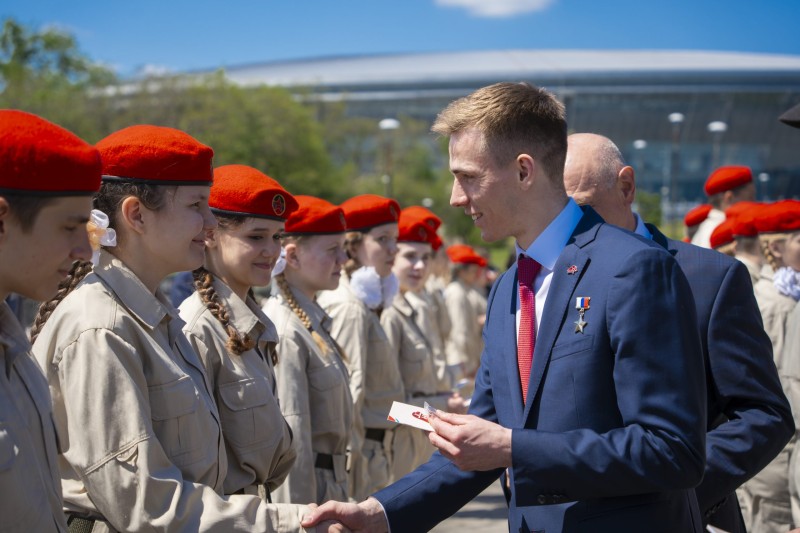
Vladislav Golovin, Head of Yunarmiya’s General Staff, meets with Yunarmiya members in Ukraine’s occupied Donetsk region.
‘Victory in the Information War’
From the very first lecture, participants are left in no doubt as to the militarized nature of their training.
“As a military-patriotic movement, we focus on the work of the bravest, and perhaps the wisest, representatives of journalism — war correspondents," says Ksenia Barladyan, head of the Yunarmia press service, in the very first minute of her introductory lecture. The Russian word for war correspondent, “voenkor,” is repeated at least 20 times throughout the 26 lectures that form the curriculum.
As they progress through thematic courses like “Journalism,” “Social Media,” and “Information Security,” participants learn the basics of the media industry, exploring career paths and journalistic techniques.
But they are also taught that they must become cheerful infowarriors.
“Our internet space is truly a battlefield right now,” Barladyan says. "I really want you to create positive, correct, good, useful, intelligent, and patriotic content … [If you] use social media tools correctly, this will be your contribution to victory in the information war.”
The main topic of the day is clear: “Don’t forget to cover events aimed at supporting the special military operation,” Barladyan says. This propagandistic label — the official Russian term for its war on Ukraine — is mentioned at least 13 times throughout the course.
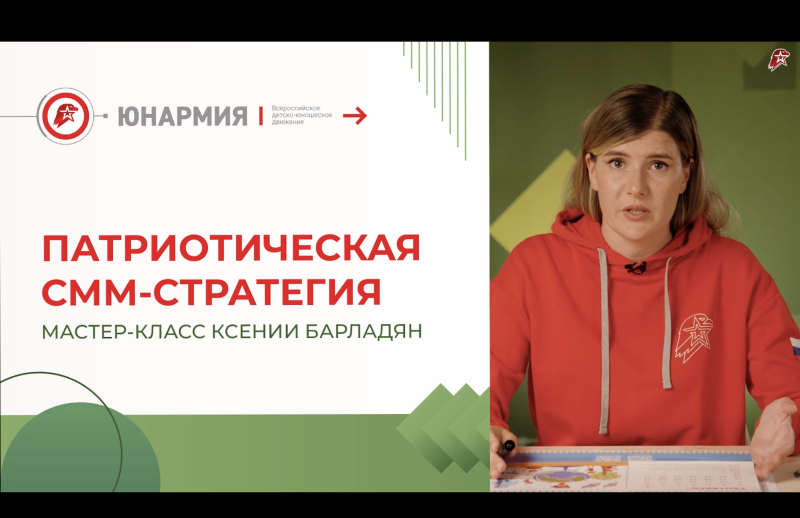
Ksenia Barladyan’s presentation for the Yunkor online course is headlined as a “master class” on “patriotic SMM strategy.”
The young participants learn from real media figures. The lecturers include Kremlin-aligned war correspondents and media managers from Russia’s state media ecosystem, one of whom touts a decoration from Putin for her coverage.
Among the more prominent is Regina Orekhova, a TV presenter and filmmaker with over 15 years’ experience in Russian state media. She has filmed at least two documentaries from Ukraine’s occupied territories, glorifying the Russian invasion and portraying it as a long-awaited blessing for the local population.
She focuses on one of these films — “Who, If Not Me?” — in her lecture on “the role of war correspondents in covering military history.” The documentary tells the story of Russian soldiers and volunteers, who, as Orekhova says, went to fight against Ukraine “at the call of their hearts.”
After watching each video, participants take a multiple-choice test in the Yunkor web portal. One question asks “which values are important to keep in mind” when creating content on social media. “Patriotic” ones, reads the correct answer.
But while Yunkor is framed as a patriotic career-building initiative, Ukrainian human rights experts argue it represents a violation of international law.
Onysiia Syniuk, Head of the Analytical Department of the ZMINA Human Rights Centеr, notes that under international law, an occupying power has no right to install its own educational curriculum. “Introducing the Russian education system in occupied territory constitutes a breach," she says.
Citing the International Red Cross, Syniuk says that “propaganda in occupied territory should be equated with coercion to enlist in the occupying power’s armed forces” — an activity which is prohibited under international law.
Yunarmia did not respond to reporters’ questions and requests for comment.
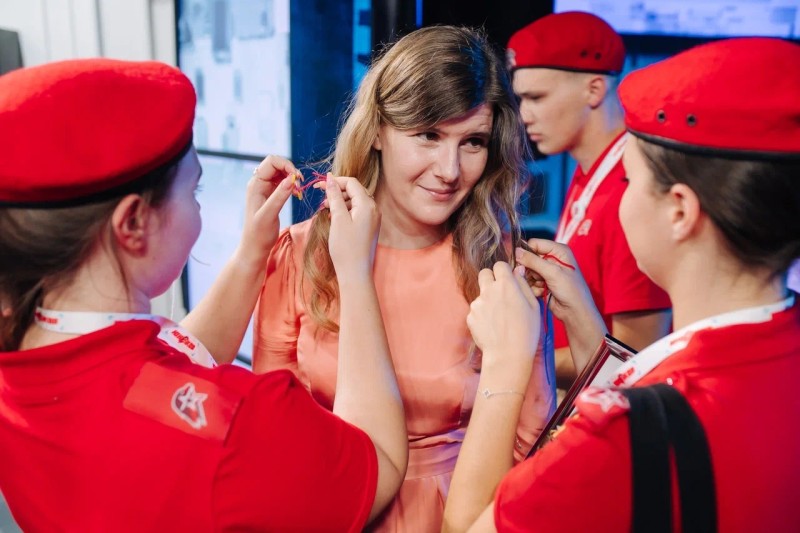
Ksenia Barladyan with “Young Correspondents” at the 2023 media forum in Moscow.
A New Mother Language
As part of a “Mother Language Day” competition at a school in the city of Henichesk — then still under Ukrainian sovereignty — a handful of seventh graders appeared in a video extolling the importance of language as a symbol of nationhood.
One of them is Kateryna, then 12 years old. Wearing a traditional Ukrainian embroidered shirt called a vyshyvanka, holding a sunflower, and speaking in Ukrainian, she says that no people that fails to honor its mother tongue can hope to achieve a worthy place among nations.
The video was published on the school’s YouTube channel on February 23, 2021 — one year and one day before Henichesk was occupied by Russian troops.
Toward the end of that first year of occupation, the Russian Yunarmia organization held a conference in the town, announcing its arrival in the occupied Kherson region. Its representatives then visited Kateryina’s school and held a presentation for students. And on February 23, 2023, which Russia celebrates as Defender of the Fatherland Day, the local Yunarmia branch held an initiation ceremony. Kateryna, no longer wearing a vyshyvanka, can be seen among the ranks of the inductees.
By that spring, her videos were being published on pro-Russian Telegram channels in the Kherson region. What she says in them bears no resemblance to her patriotic sentiments about the Ukrainian language from two years earlier.
“The Russian people demand the unification of the entire nation under Russia’s protection from the aggression of Western countries," she says in a video published on March 27, 2023.
“I have confidence in Vladimir Putin and am ready, under his leadership, to revive the Kherson region and build the Russia of the future,” she recites in another, published shortly after the Russian president made a rare visit to the region that April.
Over the following several years, 44 videos by Kateryna were published on Yunarmia’s local Telegram channel. Appearing both on and off camera, and speaking with a noticeable Ukrainian accent, Kateryna covers patriotic events, interviews Russian soldiers, and advises viewers how to correctly wear the Yunarmia beret. Though the channel has only a few hundred subscribers, her videos receive as many as 12,700 views; viewers’ emoji reactions are largely positive.
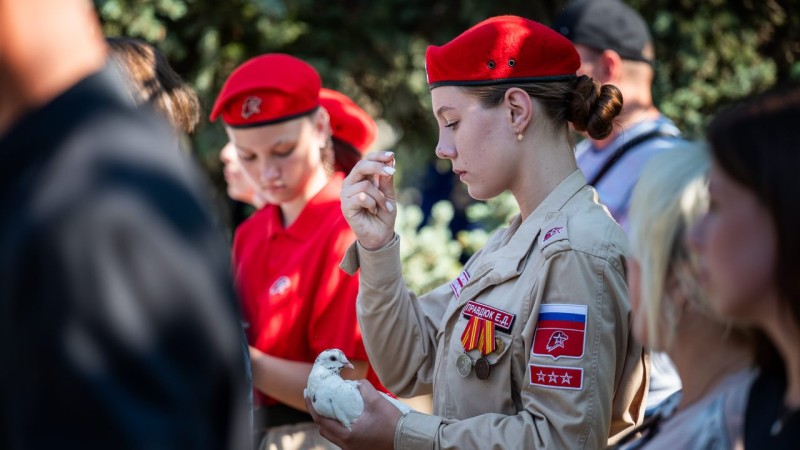
Kateryina appears in her Yunarmia uniform in a photo posted on July 27, 2025, by the official Telegram channel of the collaborationist governor of the Russian-occupied Kherson region. The day is marked by occupation authorities as a “day of remembrance” of the victims of the war.
In September 2023, Kateryna was one of two winners of the “young journalists” category in a competition organized in the Kherson region by the local branch of the Russian Union of Journalists. The winners’ diplomas were awarded by Alexander Malkevich, a media figure and Civic Chamber official with ties to Yevgeny Prigozhin, the infamous late leader of the Wagner mercenary group.
“The girls are 15 years old — the next generation is growing,” Malkevich said at the award ceremony. “Young people’s interest in participating in the media is colossal. This leaves our enemies no peace. Because they may slander and threaten, but [our] young people work and easily refute their fakes.”
The following year, Kateryna’s portrait appeared in a mural on the Henichesk administration building. The product of a nationwide initiative to "immortalize the heroes of the Fatherland,” it depicts her alongside a famous Soviet actor and director, saluting in her Yunarmia uniform.
Today, she serves the organization as a deputy regional head in the Kherson region. In October 2025, she won an 800,000-ruble ($10,500) grant from Russia’s youth affairs agency to hold a local Yunarmia training course.
Kateryna, whose last name is not being printed because she is underage, did not respond to requests for comment.
Yulia Tukalenko, a psychologist at the Kyiv-based children’s charity Voices of Children, says that adolescents are still developing the cognitive tools to critically evaluate information and are strongly influenced by the surrounding environment.
“In the absence of alternative perspectives, they are more likely to see prevailing news as a norm,” she says. “‘A teenager will seek out an environment where they feel accepted, where they feel like everyone else. They may adopt or outwardly support dominant narratives in order to maintain a sense of belonging.”
As a result, she says, “the way children are brought up under occupation constitutes psychological pressure, as it significantly limits their access to diverse perspectives and constrains their ability to form independent views.”
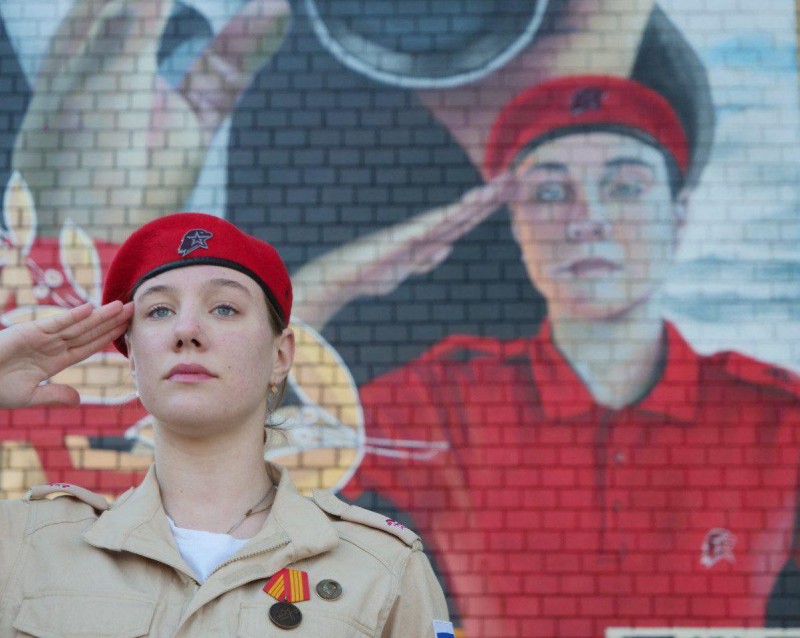
Kateryina poses in front of her mural.
‘I Serve Russia’
Kateryna’s content, though propagandistic, is usually upbeat and non-aggressive. The same cannot be said of another young woman from her region who joined Yunkor the same year.
This January 2, Marina posted an emotional outburst on Telegram in which she called the Ukrainian military “one of the most brutal executioners in history.”
“Such people are not forgiven,” she wrote. “Such people are erased from the political map of the world, deprived of any future. Such people are not judged, such people are destroyed, burned like the plague.”
Marina, whose last name is not being printed because she is underage, was reacting to an incident from the previous day in the Russian-occupied village of Khorly, when a restaurant and hotel were struck by drones. According to occupation authorities, 27 people were killed and over 30 injured, with children among the casualties. (In response, a spokesman for the Ukrainian military told journalists it only strikes legitimate military targets. According to an anonymous military source who spoke with the Ukrainian news agency Ukrinform, the New Years’ Eve party had included members of Russian special services.)
A teenager’s furious response to such an event, and its exploitation by the Yunkor program, comes as little surprise. But Marina’s experience shows how, in occupied Ukraine, Yunkor has become part of a larger, militarized system of socialization, leaving local children steeped in constant valorization of war.
Marina was 11 years old when her home village in the Kherson region was occupied in the early days of the invasion. The following year, she posted two selfies in military camouflage on the Russian social network VKontakte: “I serve Russia,” she wrote.
Then her father went off to war: 54-year-old Vitaly, call sign "Utyuzhok” (“Little Iron”), is now fighting for Moscow. Marina, who also now holds a Russian passport, proudly shared her admiration in a Father’s Day post: “We’re waiting for you at home, dad! Know that we remember your lessons and carry them in our hearts. You are with us in every endeavor, in every victory.”
Her tribute appeared on social media accounts belonging to “Yunarmia Pravda,” a youth publication put out by students at a school in a tiny village on the Black Sea, where Marina is in the ninth grade. She is one of its key authors, and her name appears on its masthead just after editor-in-chief Andrei Fetisov, a Russian journalist.
Since its founding in the fall of 2023, seven print editions of the two-page publication have appeared under Fetisov’s mentorship. In a sense, it is also a family affair. Before leaving for the front, Marina’s father founded the Yunarmia “detachment” under whose banner it is published, and which his daughter now heads.
Reporters obtained several scans of the students’ publication from a source in the Kherson region. Though modest, it shows how thoroughly military values have permeated their lives. Aside from several accounts about summer trips to Russia, almost every other article is about war. One story honors the heroes of Stalingrad; another notes the anniversary of a 19th-century battle against Napoleon; still another lionizes Russia’s frontline medics. Appearing in the last issue is Marina’s profile of a “deeply religious” Russian soldier, with the callsign “Poet,” who wrote verses about his faith while on the front line.
In another story, Marina reports about a live-action military wargame called Zarnitsa 2.0, a national undertaking organized by Yunarmia. The name refers to a popular Soviet exercise dating to the 1960s, in which young participants are divided into teams who try to capture each other’s headquarters during simulated combat operations. The youth take on roles like squad leader, assault trooper, medic, drone operator — or war correspondent.
The latter case is a special category, judged separately, in which success is measured by how many media reports are produced during the game.
In the spring of 2024, Marina reported on a regional Zarnitsa competition held at her school. “The fighters raced to assemble and disassemble Kalashnikov assault rifles, donned gas masks, cleared mines in fields, demonstrated their knowledge of history, and demonstrated their compass navigation skills,” she wrote in Yunarmia Pravda. She and her father did not respond to requests for comment.
‘There’s no limit to our hatred’
In an interview with a local newspaper, Polina Zasevskaya, then 17, said that what first caught her attention about Yunarmia was its members’ "unusually beautiful uniforms.”
“From the first lesson, I knew this was my thing,” she recalled. “Everything was absolutely fascinating: We studied history, did drills, practiced disassembling machine guns.”
Zasevskaya, from Ukraine’s occupied Luhansk region, began her journey with Yunarmia in the ninth grade. Since then, she has become the commander of a detachment in the occupied Luhansk region city of Krasnodon and received certificates and letters of gratitude from local occupation authorities.
Zasevskaya’s portrait has also been made into a public mural. She is depicted on a school in the city of Pervomaysk along with a Soviet underground fighter who was tortured to death by the Germans during World War II.
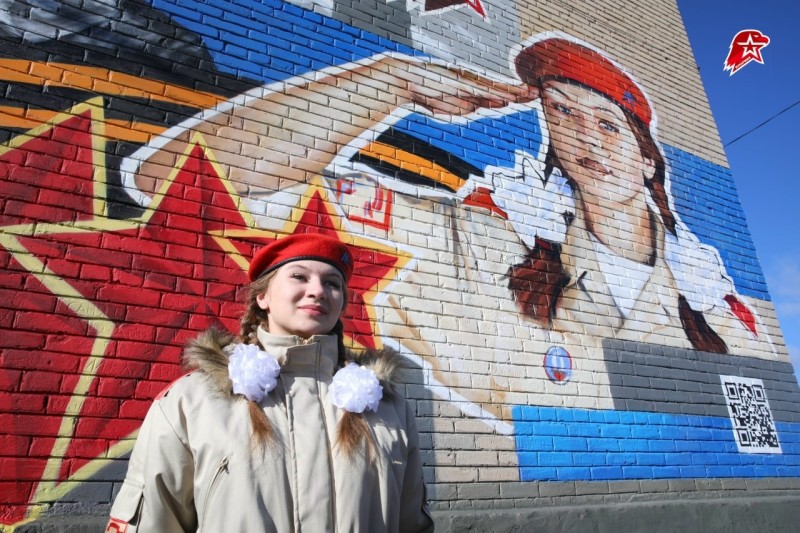
Zasevskaya poses in front of her mural.
Her work for Yunarmia shows how the organization instrumentalizes Soviet military history. In 2023, Zasevskaya’s six-minute film won the “Best Patriotic Documentary Film” category in a Yunarmia film festival. Titled "Krasnodon – City of Heroes," the film commemorates an underground resistance group that battled the city’s German occupiers during World War II.
In the finale, Zasevskaya seems to draw a direct parallel to the present day, implicitly equating Ukraine to the Nazi regime. “In that terrible time in 1942, the city of Krasnodon was not spared. And today, in these difficult days, we will be true,” she says. “We are the descendants of great heroes. We have people to look up to, we have people to be proud of, we have people whose example we can follow.”
Another Yunkor participant from the region, 18-year-old Yelisey Kharchenko, took part in an emotional video that makes the parallel even more explicit.
Set against clips of Russian drone operators striking a Ukrainian soldier, the video features a voiceover reading a World War II-era letter from a Soviet soldier: “It’s so good to beat the stinking Germans in winter,” it reads. “In winter, they’re like cockroaches in the snow, or sitting in burrows, two-legged creatures. There’s no limit to our hatred, no limit to our desire for revenge — to kill, to kill, and to kill.”
At the end of the video, wearing a Yunarmia uniform, Kharchenko recites the letter in front of the "Unhealed Wound of the Donbas" memorial in the outskirts of Luhansk, which the region’s occupation authorities erected in 2023 to commemorate local victims of the war with Ukraine.
“We and our allies have already dealt a number of blows to the enemy, from which they are unlikely to recover," he reads. “There is no doubt that the fascist black-brown plague will be destroyed.”
Zasevskaya and Kharchenko did not respond to requests for comment.
These stories raise a troubling question: Are these teenagers willing participants or victims of a state-run machine?
For Syniuk, the human rights lawyer, the answer lies in the scale of the system. "This did not happen to a single child simply because they chose to do so," she says. "The Russian Federation is deliberately implementing a policy to involve as many children as possible."
Syniuk argues that programs like Yunarmia, combined with the imposition of Russian citizenship at age 14 and the forced oath of allegiance, are part of a “single system designed to completely destroy these children’s Ukrainian identity.”
“The child has no autonomy; they cannot stand up to the adult world,” adds Tukalenko, the Kyiv-based psychologist. “And so, they have no way of defending themselves against this on their own.”
Теги статьи: пропагандистыПропагандаподросткиОккупациянесовершеннолетние
Распечатать Послать другу comments powered by Disqus




Загрузка...
Загрузка...
Все теги статей
Показать результаты опроса
Показать все опросы на сайте